







The highly anticipated feature Backrooms movie has finally revealed itself, appearing as though it was always… there, waiting, a sickly fluorescent light flickering behind a door that was always locked until today. I’m going to try to sum the film up in a couple of completely non-spoiler paragraphs, and then go into some very light thematic spoilers for a little bit, but if I think I have to give anything really vital away I’ll warn you as we go.
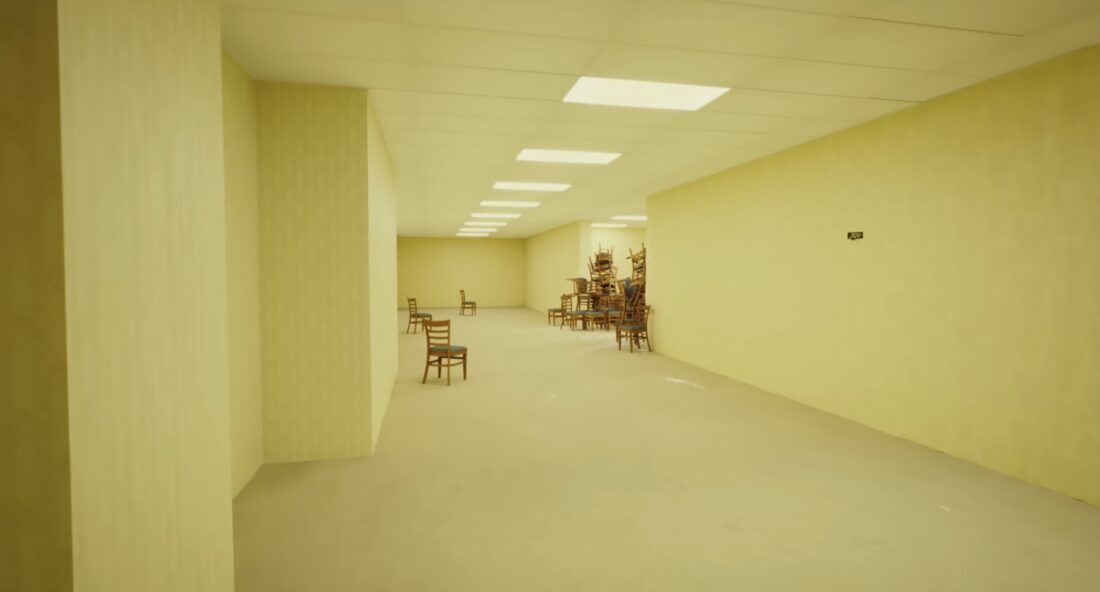
Backrooms is everything I was hoping it would be. It’s creepy and weird, but based just enough in solid reality—at least at first—that there’s room for the creepiness and weirdness to grow. The basic premise is the same creepypasta that has been popular for a few years now: A person discovers a seemingly endless secret realm of empty rooms, many of which make no architectural sense, some empty, some piled with old furniture, some with stairs that go nowhere or doors that won’t open.
Once discovered, the space seems to exert an almost mystical pull on the person—they need to explore it, even as it becomes clear that it’s really not safe.
Liminal spaces are excellent for horror, of course, but I’m really, really excited that this is a movie where the liminal space IS the horror. The thing that creates the sense of dread, and even terror, is the space itself. The emptiness, the wrong-ness, gets to you long before you notice that one of the shadows in the corner looks darker than it should, or you hear footsteps in another room. If you love the creepypasta, I think you’ll love the movie—but also this is simply a great work of modern horror that stands on its own. You don’t need to know anything about the lore going in.
I think writer Will Soodik and director Kane Parsons take this premise in a lot of gorgeous directions. It’s genuinely tense, and scary, and uncanny, and every time I thought they’d gone as deep as they could, they found a new layer. The camera work is superb; cinematographer Jeremy Cox doesn’t use over-the-top Dutch angles, but things seem tilted enough to never feel quite stable, and a lot of the footage is grainy and nauseating even when nothing is technically “wrong”. The carpeting in the room dulls the sound, but the emptiness makes every sound ECHO. This is the kind of movie that will get into your dreams even if it doesn’t scare you during its runtime—but I think chances are high that it will scare you during its runtime. The sense of dread is instantaneous, the camerawork builds that dread without relying too much on cheap jump scares (there are jump scares, but they’re not cheap), the humor and meta references work beautifully, and, like a lot of horror right now, this movie has something to say. Like a lot of horror, this movie is about trauma (but not an easy, pat way), and even more than that, it’s about loneliness.
Are there people out there who deserve to be alone?

The cast is small—the better to isolate them in a yellow-lit room with chairs that don’t make sense. Chiwetel Ejiofor is Clark, a depressed furniture store owner who stumbles into a liminal space at work, and finds it taking over his entire mind. Renate Reinsve is Dr. Mary Kline, a therapist who’s recently published a successful self-help book. Lukita Maxwell is Kat, Clark’s employee, and Finn Bennett is Bobby, her boyfriend, who owns a video camera. And then there’s Mark Duplass as Phil, who plays a tiny but pivotal role.
From here on I will get into very light spoilers after telling you once again that if you’re enjoying our current wave of excellent horror you’ll probably want to get out and see this in a theater with other people if you can. So if you want to know absolutely nothing, skedaddle back through whatever uncanny portal brought you here, or click here to skip past the spoiler section.

Now if you clocked my mention of “video camera” there a second ago: Backrooms is set in 1990. I didn’t know that going in, and it takes a few minutes to become obvious, but it’s the best choice for this film. The furniture, the cars, the clothing, the hairstyles, all of it works. Unlike the director of this film, I can remember 1990, and I think this movie gets everything exactly right. Also, as with Kyle Edward Ball’s 2023 Skinamarink, people who were young and vulnerable in the 1990s might get an extra jolt of queasiness from all the cultural clutter that the movie takes for granted.
But what the setting does that’s brilliant is: remove cellphones from the world, and along with them any mention of Facebook, Twitter, TikTok, Insta, Snapchat, Youtube, Vine—all the ways that ordinary people would record and chart the Backrooms are still at least 15 years in the future. If you try to tell someone about the Backrooms, you’re going to sound mentally disturbed. If you want to record them, you’re gonna have to bring a video camera, and it’s gonna to be a video camera you could use in 1990. Even the ones the Blair Witch kids took into the woods were sleeker and easier to carry.
The other thing this does is link the film directly to the A E S T H E T I C movement of Vaporwave from 15 years back, that amorphous burst of nostalgia for a made-up mashup of the early ‘80s and early ‘90s, that as far as I could tell was created by people who weren’t born in time to experience either, and gleefully swirled them together into a cultural Orange Julius.
There are moments here where people stumble into a room that echoes one of those abandoned, flooded malls full of fish. There are rooms that look to be riffing on gym pools, beach cabanas, homes at various socioeconomic levels. At all times the film feels like a dream, and operates increasingly on dream logic. As a result, everything makes sense as you watch, but the further I’ve gotten away from it the more the images have bubbled up and struck me as nauseating. (What I’m really excited about it watching this sucker at home when I can pause it and look for details.) But on first watch, every moment of the film felt true, like a dream I had as a kid and never quite shook. Even the one moment where I thought the film might be veering off-course went in an unexpected new direction, and restored my trust in the movie before it ever fully broke it.
Liminality in anthropology and the study of religion is pretty straightforward: a liminal period is the time between the beginning and end of a rite of passage. If a young person has to go through a particular ordeal to be considered an adult, then that ordeal is a kind of liminal space. A young kid studying for a Confirmation or Bar/Bat Mitzvah ceremony is in an in-between state that can be considered liminal: when they start their classes, they’re a child; when they complete the ritual with their family and community they are, in the eyes of their religion, a rational adult with the responsibility to behave rationally. A couple on their wedding day are in a liminal period until the officiant declares them married, or they kiss, or possibly, depending on the culture, until they’ve consummated the marriage. Certain kinds of holidays can be liminal periods—Samhain, Dia de Muertos, Eid al-Fitr and Eid al-Adha, Yom Kippur—all acting to guide people from one part of the year, with specific rules and guidelines, into another.
On the internet, a liminal space is a physical space, an empty room or hallway or storage facility that, for whatever reason, feels uncanny. Maybe there are no windows, maybe things seem a little too symmetrical, maybe the heights of the ceiling makes no sense, maybe there’s a small door. It can be anything from just a room all the way up to a sort of M.C. Escher or Piranesi-esque space.
Since Backrooms is set in 1990, when only a certain kind of military wonk knew of this thing that would become “the internet”, the movie is able to start fresh and sweep all the creepypasta clutter, fun as it is, out one of those weird small doors. Much like with my other recent favorite Hokum, there’s no winking. Ohm Bauman never mentions Stephen King or Stanley Kubrick—he just has to figure out how to survive in a haunted hotel. Clark can’t hop onto TikTok to figure out how to navigate a Backroom. The people in the film have never heard the term “the backrooms”. They’ve never been in a Discord chat. There is no preexisting lore for them to riff on, no well of knowledge to use as a shield. They think they understand reality, then they know they don’t.
You know, horror.
The other choice Parsons and Soodik make, which I think might be the biggest key to the film’s success, is that they explain nothing. We don’t know why the Backrooms exist, we don’t know how, we don’t know how many there are or how many people know about them. The Backrooms are simply a nightmare with their own rules, and you either survive or you don’t. I know there are going to be more of these films, and I dearly hope that they don’t explain all of this horrific magic away.
OK, I’m done even lightly spoiling things, you can come back! From here on in it’s a personal essay.
After the movie two profound things happened. First, my friend and I went to a diner, and I descended into their basement to use the bathroom, and this happened:
Second, after I told my friend a little bit about my childhood, she said “you were raised by liminal spaces.” And thinking about it that way feels strange, but she’s right: I was.
My first few years were spent deep in the woods halfway between Pittsburgh and the West Virginia border, in a town that wasn’t so much a town as much as a blinking yellow light at a gas station (the gas station was also a pizza joint, and you could buy weed there) where the accents were Appalachian in one direction, and full nasal Rust Belt Pittsburgh in the other. My family was Pre-Vatican II Catholic, my neighbors were tongues-speaking Pentecostal.
I spent a year living in a hotel, which once school let out that meant I was running wild through empty rooms, storage spaces, a ballroom no one used anymore, the shuttered restaurant, the new bar as it was being built. As my parents desperately tried to salvage the place (their business partner, uhhh, well, departed earlier and wealthier than they expected him to, let’s say), I was left largely to my own devices, and those devices involved elaborate games played around piles of old furniture and busted TVs that no one had thrown out yet.
After that, when my dad returned to his old job of managing malls—well, you can see where this is going, can’t you? The next few years worth of free time were spent in the echoing back hallways of malls, the echoing main thoroughfares of malls after closing. Empty spaces where the quiet became a physical thing to navigate, dark, shadowy corners, flickering fluorescent lights, broken detritus and stuff no one liked enough to buy.
Which is my roundabout way of saying that Backrooms made me homesick.
I loved the way this movie made me queasy, I loved all of its weird choices and unsettling corners, and I can’t wait to stumble back through that totally normal-looking wall.

Let’s hope furniture-adjacent horror catches on and we get adaptations of Nino Cipri’s Finna and Defekt.
I enjoyed it, but thought that it was hard at times to tell what was audio in a scene, and what was part of the soundtrack.
I very much enjoyed Backrooms! And I heartily agree that the non-explanation was crucial. Early on in the movie I began to dread that they might explain it. I was going to flip a table if they did. But I felt they *really* did the rest of the movie justice with the ending.
And thank you for making this review so personal. That video you took freaked me out (!!) and reminded me of when I went to the train station after seeing Exit 8 and immediately spotted a bright white tiled corridor I’d never noticed before going at an odd angle from the station. It was ominous as hell. I love it when movies follow you out of the theatre! I still remember that feeding street cats before dawn after watching It Follows was excruciating. Literally anyone walking down the street was a source of terror. Genuinely a delight.
And your description of your liminal childhood was terrifying. Not that it would have been terrifying to live, but what a great series of horror films! (I’m going with Dead End [2003], Hotel [2004] and Dawn of the Dead [1978].
I already have a recurring dream in which I get lost in a mazelike building complex (school, office, hotel, etc). I’m not sure if watching this movie would make it better or worse.
I have that kind of recurring dream, too, and while, with only one night of sleep on record since, I have no conclusions to make as to its effect on my dreams, being familiar with that kind of dream certainly ramped up my feelings watching the movie. Having been 16 in 1990 didn’t help much, either.
Leah’s discussion of liminal spaces also brought back a very disconcerting experience I had walking my dog at night in Salt Lake City (a city with a very serious commitment to a gridded street layout) and winding up on the far side of a familiar park that, according to the laws of physics, just should not have been where it was. That sort of experience sticks with you harder than any silly dude with a hockey mask.
Feels to me that someone read the story “The Yellow Wallpaper” and moved it to our time period.